Colonel Tom’s grief and panic after his daughter’s death
Night TrainColonel Tom’s grief and panic after his daughter’s death shape the investigation as well as his private response to loss. He is visibly shaken, and the prospect that Jennifer died by suicide is so difficult for him to bear that he clings to the possibility of another explanation. Later, even when the search seems to have supplied a why, the unresolved question of who Jennifer was shows that an explanation cannot restore the daughter he has lost.
First Signs of Grief
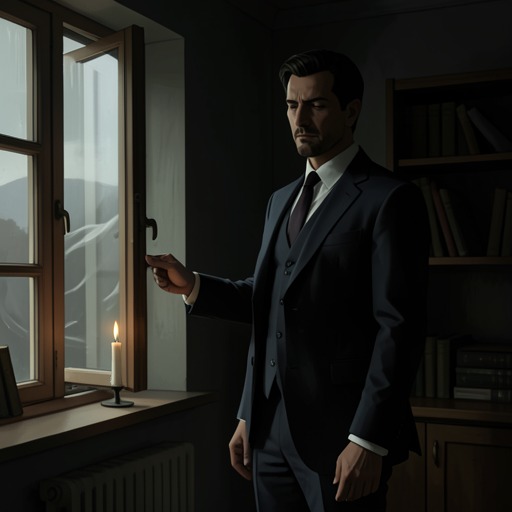
At Mike Hoolihan’s desk, Colonel Tom does not accept the hug Mike offers. He keeps his chin down while taking off his coat and remains head-low when he sits. Asked how he and Miriam are, he shrugs, exhales, and eventually asks about his wife; Mike hears that she is very quiet. The exchange conveys grief through restraint and small gestures rather than an account of what the family is feeling. Colonel Tom’s lowered head and Miriam’s silence establish a household subdued by Jennifer’s death.
What Mike sees in Colonel Tom’s eyes is not only sorrow but panic. Mike describes the reaction as primitive and says it makes him panic too, imagining that Colonel Tom might begin screaming and wondering whether the fear would spread. This moment makes grief an encounter between the two men: Colonel Tom’s distress is so stark that the witness feels pulled into it. Mike’s own alarm does not resolve the scene; it registers how little either man knows how to do with the intensity of the loss.
Panic and the Search for Another Explanation
As the investigation continues, Colonel Tom’s appearance carries the strain forward. Mike observes that, in other officers, a case that was wearing them down could show in the pattern of their shaving and in signs of prolonged wakefulness. Colonel Tom’s cheeks are smooth, but the pain beneath his eyes seems to deepen and harden. The contrast makes his distress legible without reducing it to a single outward sign: he has maintained one ordinary routine, while the strain remains visible elsewhere.
Colonel Tom resists accepting suicide as the account of Jennifer’s death. He imagines that she may instead have suffered violence and tells Mike that he believes there is evil in a suspected man. The possibility of a violent death is not presented as a settled finding; it is the alternative Colonel Tom needs to consider because, to him, it is more bearable than the thought that Jennifer chose to die. His speculation therefore reveals both his fear for what may have happened to his daughter and the emotional pressure shaping his interpretation of the evidence.
He then turns to a laboratory report and tells Mike that Jennifer tested positive for sexual evidence. He emphasizes the finding as he presents it, making clear that he sees it as relevant to his suspicion that another person was involved. The report intensifies the search for an external cause, but it does not, by itself, establish who was responsible or change the basic uncertainty surrounding Jennifer’s death. Colonel Tom’s need for an answer runs ahead of what the evidence can settle.
A Cause Without an Answer
Later, Miriam says that she and Mike have turned a corner, and that Colonel Tom is back after a period when she thought they had lost him. She describes him as steadier, and he appears to look through the fog that had surrounded him. Her account marks a change in his condition, not an end to the grief: the language of returning and stabilization suggests a measure of regained composure, while the loss remains the reason the family is speaking at all.
The apparent change is paired with a new formulation of the problem. Miriam says that they had been looking for a why and had, in some sense, found one, but now lacked a who. She presses Mike to answer who Jennifer was, naming possible investigators as people who might be asked to decide. The demand shifts the question from the circumstances of death to the identity of the person who died. Even if a cause can be proposed, it cannot explain Jennifer completely or make her choices transparent to those who loved her.
Grief That Remains Unresolved
Colonel Tom’s movement is therefore not from grief to certainty. At first, panic drives him toward a suspected perpetrator and away from the possibility of suicide; later, a provisional sense of having found a why gives way to the harder question of who Jennifer was. His family sees him become steadier, but Mike is still asked to supply an answer that the investigation cannot simply produce. The gap between those questions gives Colonel Tom’s grief its continuing force: an account of what may have happened is not the same as understanding his daughter, and neither can undo her death.